
In “Nusayba Knows Her Worth,” I reference the hadith about Nusayba (aka Umm ‘Umara) asking the Prophet (S) why the Qur’an only appears to address men. In response, Allah revealed ayah 35 of Surah al Ahzab which lists the attributes of men and women who will receive Allah’s just reward.
As I was planning activities around self-worth for my last masjid reading, I was struck by just how perfectly this ayah and the event that led to it aligned with my purpose. When Nusayba bint Ka’ab questioned the Prophet (S), she was coming to him as a faithful, committed Muslim who performed valiantly on the battlefield and suffered several injuries. Naturally, a person like that would feel they had earned Allah’s rewards and would wonder why they were seemingly excluded. When I read the response from Allah with that context in mind, it sounds as if Allah is reassuring Nusayba—and all believing women—of their worth. Forget about gender, ask yourself if you are any of the things listed in this ayah. If so, then you are worthy of Allah’s forgiveness and a great reward.
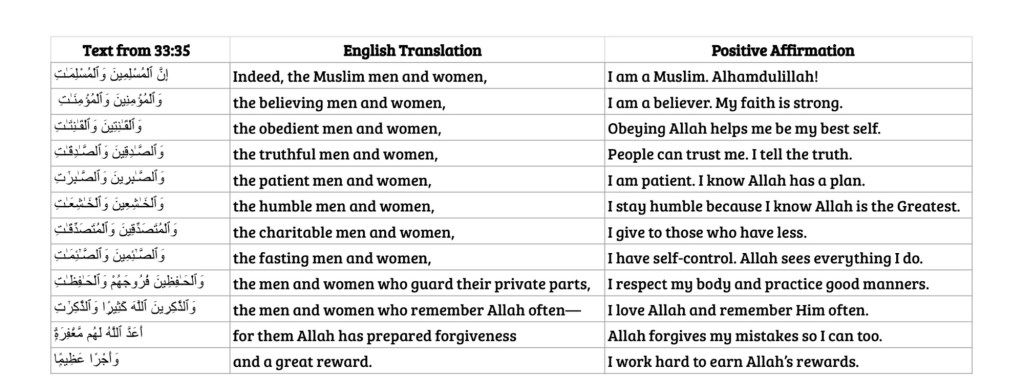
In listing the attributes of those who are worthy, the ayah serves as the perfect source for developing positive affirmations from an Islamic perspective. When I say that, I mean that I’ve seen in the secular practice of affirmations a very individualistic and self-centered theme. Some individualism is of course healthy, but Muslims strive to center our sense of worth around where we stand with Allah.
See the table below where I have broken down the ayah by attribute. In the third column, I created age-appropriate affirmations for kids to read aloud. I’ve started reading them with Nusayba and we’ve had some great discussions unpacking some of them.
If you gain any benefit from this, the credit is to Allah. If you find anything harmful, the mistake is mine.
 Golden Butterfly Books